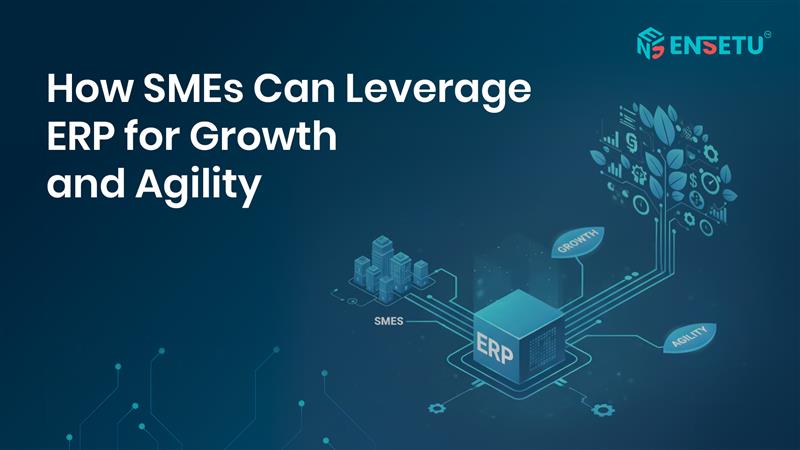
Small and mid-sized enterprises often grapple with a range of different tools, manual tasks, and uncoordinated data. This will work for a while, but as the company grows, it will become frayed at the seams. Teams will work slowly, errors will be common, and decision making will be difficult. This is where modern ERP solutions make a true difference. While once reserved only for larger enterprises, today’s ERP solutions come with less complexity, are more cost-effective, and are designed to support SMEs who aspire to grow confidently.
1. Centralize and Streamline Core Operations
As businesses scale, they will naturally bring on different systems for different projects/functions. Finance will use one tool, the sales team will depend on another, and inventory might still be tracked via spreadsheets. This leads to siloed information that inhibits collaboration. A true ERP centralizes everything into one location.
Instead of switching back and forth between several tools, teams can communicate and collaborate as a unified measure within a single platform. The combination of one shared platform and information flow will increase efficiency and eliminate a lot of confusion. ERP significantly improves SME operational performance by reducing inefficiencies. Finally, a centralized operation can empower SME companies with the ability to:
• Eliminate manual errors
• Improve visibility across departments
• Establish consistent workflows
• Increase coordination between teams
This essentially lays the groundwork for cleaner, healthier growth.
2. Make Faster, Insight-Driven Decisions
Decision-making is guesswork in the absence of business data. In fact, many small and medium-sized organizations still operate with weekly or monthly reports that come too late to act upon. An ERP system will eliminate all of that guesswork by providing real-time information.
Leaders can see what is happening in real-time, rather than what happened the previous month, allowing for clarity, action, and confidence. A business-impact study found that ERP-driven digital transformation helps SMEs make quicker, more accurate decisions based on real-time data.
With a good ERP system, organizations can:
• Observe sales trends both advancing and declining
• Understand cash flow instantaneously
• Anticipate demand more accurately
• Identify potential risks proactively
The decision-making process becomes sharper and more reliable.
3. Automate the Routine
Growing organizations often notice as they scale, the team becomes drowned in repetitive administrative work. Hours are spent involved in drafting invoices, updating inventory records, issuing reminders, and approving routine requests. ERP systems have automation that takes the burden off unproductive tasks. This helps employees reallocate their time towards things that have more value and avoid manual inputs.
Automation can help SMEs:
• Generate documents automatically
• Sync orders and inventory in real time
• Eliminate repetitive data entry
• Reduce the chances of human error
Productivity rises, and everyday operations feel less hectic.
4. Improve Customer Experience Through Better Coordination
Today’s customers expect quick responses, accurate timelines, and smooth interactions. When internal systems are disorganized, customers are the first to feel the impact.
ERP improves customer experience by keeping all teams aligned. Everyone has access to updated information about orders, stock, pricing, and service requests.
This leads to:
• Faster resolutions
• More accurate delivery dates
• Better communication
• Smoother order handling
A more coordinated internal system naturally creates a more satisfying customer experience.
5. Scale Easily as the Business Grows
Growth is exciting, but it also brings complexity. More products, more transactions, more staff, and more moving parts. Without the right systems, this can quickly overwhelm SMEs.
ERP platforms grow with the business. They make it easy to add new users, locations, processes, and even whole departments without breaking the existing workflow.
As SMEs expand, ERP helps them:
• Add new modules whenever needed
• Manage larger transaction volumes
• Maintain consistency in operations
• Support multi-location environments
Growth becomes manageable instead of chaotic.
6. Strengthen Compliance and Data Security
Compliance and data security are becoming major challenges, especially for sectors that handle financial or customer-sensitive information.
ERP systems simplify this by offering built-in security tools and compliance features. Businesses can control who accesses what, track changes, and generate accurate reports when needed.
This provides SMEs with:
• Role-based access control
• Secure and organized data storage
• Automated regulatory reports
• Audit trails for accountability
The result is a more secure and compliant business environment.
7. Enable Remote and Flexible Work
Workplaces are no longer tied to one physical location. Teams expect flexibility, and customers expect service even when circumstances change. Cloud-based ERP supports this shift by allowing employees to access information from anywhere. Whether they are at home, in the field, or on-site, they can work with the same efficiency.
Remote-enabled ERP helps SMEs:
• Keep teams connected
• Share updates instantly
• Support field and sales teams
• Maintain productivity during disruptions
Flexibility becomes part of the company culture instead of an operational burden.
8. Unlock Competitive Advantage at Lower Cost
Many SMEs believe ERP is too expensive or too complicated. Modern ERP systems prove the opposite. They are affordable, scalable, and built with small businesses in mind.
By reducing manual work, improving accuracy, and enabling smarter planning, ERP helps SMEs operate with the efficiency of much larger companies.
The cost advantages include:
• Lower IT maintenance
• Reduced errors
• Increased productivity
• Better financial control
• Improved margins
With ERP, SMEs gain the speed and clarity needed to stay ahead of competitors.
Conclusion
Many small and medium sized enterprises (SMEs) face rapid expansion owing to the extent of activity all happening at the same time. This is when the utility of an ERP system becomes apparent. It brings everything together, reduces wasted work, and provides teams with the clarity they need to take decisive action. With better visibility throughout the organization, better operational execution and better decision making, businesses can focus on what usually matters the most: servicing customers and planning for the future. For any SME that is looking to grow in a consistent, agile manner, an ERP system is more than simply a tool, it becomes a partner in your journey.